Protective Orders in Texas

2025 Statewide Survey of County Policies and Practices

Download the Full Publication 

Thank you to the Texas Bar Foundation who provided a generous grant to fund the preparation and publication of this report and subsequent training and promotion of its findings regarding best practices.
 

Listen to the full podcast episode on Spotify.


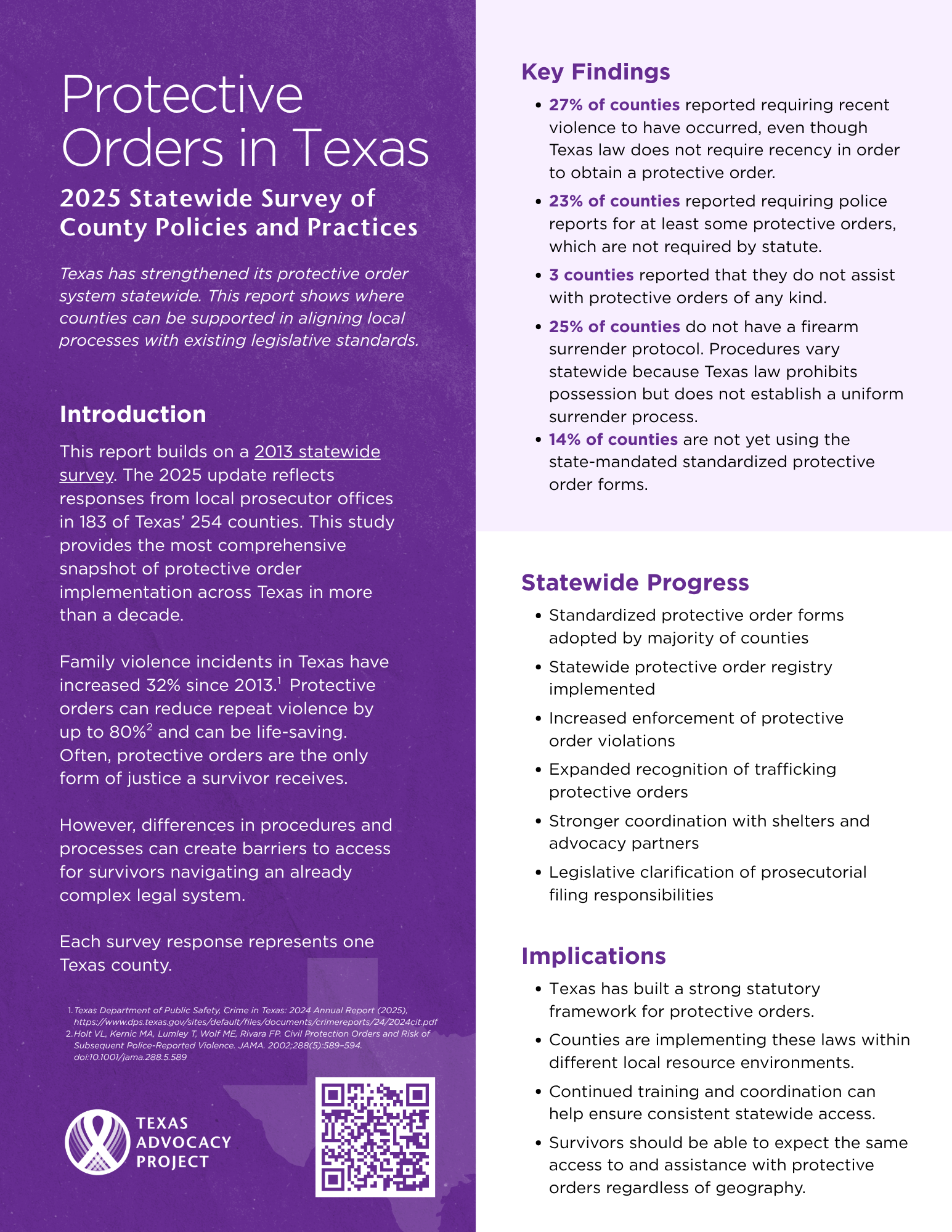
Texas has strengthened its protective order system statewide. This report shows where counties can be supported in aligning local processes with existing legislative standards.

This report builds on a 2013 statewide survey. The 2025 update reflects responses from local prosecutor offices in 183 of Texas’ 254 counties. This study provides the most comprehensive snapshot of protective order implementation across Texas in more than a decade. 

Family violence incidents in Texas have increased 32% since 2013.1 Protective orders can reduce repeat violence by up to 80%2 and can be life-saving. Often, protective orders are the only form of justice a survivor receives. However, differences in procedures and processes can create barriers to access for survivors navigating an already complex legal system. Each survey response represents one Texas county.

Findings
  • 27% of counties reported requiring recent violence to have occurred, even though Texas law does not require recency in order to obtain a protective order.
  • 23% of counties reported requiring police reports for at least some protective orders, which are not required by statute.
  • 3 counties reported that they do not assist with protective orders of any kind.
  • 25% of counties do not have a firearm surrender protocol.
  • 14% of counties are not yet using the state-mandated standardized protective order forms.
Statewide Progress
  • Standardized protective order forms adopted by majority of counties
  • Statewide protective order registry implemented
  • Increased enforcement of protective order violations
  • Expanded recognition of trafficking protective orders
  • Stronger coordination with shelters and advocacy partners
  • Legislative clarification of prosecutorial filing responsibilities
Implications
  • Texas has built a strong statutory framework for protective orders.
  • Counties are implementing these laws within different local resource environments.
  • Continued training and coordination can help ensure consistent statewide access.
  • Survivors should be able to expect the same access regardless of geography.

1. Texas Department of Public Safety, Crime in Texas: 2024 Annual Report (2025) 
2. Holt VL et al. Civil Protection Orders and Risk of Subsequent Violence. JAMA (2002)